
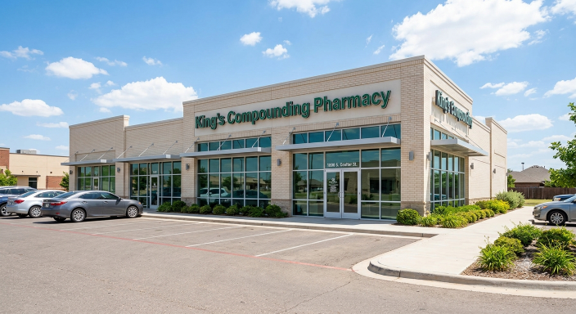
If you have been told your hormones are “off” but the standard prescription is not working for you, the problem may be the fit rather than the therapy. Bioidentical hormone replacement therapy (BHRT) is hormone therapy using hormones chemically identical to the ones your body produces — estradiol, estriol, progesterone, and testosterone — and it can be prepared in forms and strengths that off-the-shelf products do not offer. At King’s Compounding Pharmacy in Amarillo, our pharmacists have prepared customized hormone therapy for women and men for more than 25 years, working alongside your prescriber rather than replacing them.
This page explains what BHRT is, how it differs from conventional hormone therapy, what the evidence does and does not support, and exactly what the process looks like at our pharmacy on South Coulter Street. If you are ready to talk it through with a pharmacist, you can book a consultation and skip the reading.
What bioidentical hormone replacement therapy actually is
The word “bioidentical” describes chemistry, not quality. A bioidentical hormone has the same molecular structure as the hormone your ovaries, adrenal glands, or testes produce. Estradiol, progesterone, and testosterone that occur in the human body are bioidentical by definition. They can be delivered in two ways: through FDA-approved commercial products such as estradiol patches and oral capsules, or through compounded preparations a licensed pharmacy makes for an individual patient.
The two are often confused, and the distinction matters. An FDA-approved estradiol patch is bioidentical and has been through regulatory review for safety, purity, and dose consistency. A compounded estradiol cream is also bioidentical, but it is not FDA-approved and is not reviewed for safety or effectiveness. “Bioidentical” alone does not tell you which one you are getting. What compounding adds is customization — a different strength, a different base, a different delivery form, or a combination your prescriber wants for you specifically.
How BHRT differs from conventional hormone therapy

Conventional hormone therapy uses standardized, mass-produced products in fixed doses: a patch, a pill, a gel, a spray. They are consistent, well-studied, and often the right first choice. Compounded BHRT differs in four practical ways:
Dose. A prescriber can specify a strength that falls between commercial options — for example, an estradiol cream at a concentration that is not manufactured commercially.
Form. Creams, gels, capsules, sublingual troches, and suppositories let a patient use a therapy in a way they can actually tolerate and absorb.
Combination. Several hormones your prescriber wants used together can be blended into one preparation instead of three separate products.
Excipients. If you react to a preservative, peanut oil, or dye in a commercial product, a compounding pharmacist can choose a different base.
The trade-off is real: compounded preparations are not FDA-approved, their quality depends heavily on the pharmacy, and the evidence base for any specific compounded formulation is thin because formulations vary from patient to patient. We would rather you understand that than be surprised by it.
What BHRT can and cannot promise
Hormone therapy is genuinely effective for some of the symptoms women seek it for. Estrogen is the most effective treatment for vasomotor symptoms — hot flashes and night sweats — and for genitourinary symptoms such as vaginal dryness. For a woman with an intact uterus, progesterone is prescribed alongside estrogen to protect the uterine lining.
What hormone therapy is not is a cure-all, and compounded versions are not automatically gentler. Major medical organizations have reviewed the evidence and concluded that compounded bioidentical hormones have not been shown to be safer or more effective than FDA-approved hormone products, and both the FDA and the American College of Obstetricians and Gynecologists have cautioned against marketing claims to the contrary. The National Academies of Sciences, Engineering, and Medicine reached a similar conclusion in its 2020 review: the evidence for compounded bioidentical hormone therapy is limited to the specific formulations studied, and those vary. Any clinic that tells you compounded hormones carry no risk is selling you something. Risk exists in all hormone therapy and depends on your dose, your form, your age, your history, and how long you use it.
The honest position — and the one we take — is that compounded BHRT is one option among several, best considered with a prescriber who knows your history, and best judged by whether it improves your symptoms at the lowest effective dose.
Who is a candidate for compounded BHRT

Compounding is generally considered when an FDA-approved product does not meet a patient’s needs. Common reasons patients come to us:
You have tried a commercial patch, pill, or gel and had an adverse reaction to an ingredient in it.
Your prescriber wants a dose that is not available in a manufactured product.
You cannot tolerate or absorb the commercial delivery form — a pill that upsets your stomach, a patch that irritates your skin.
Your prescriber wants a specific combination of hormones prepared together.
Compounding is not a way around a proper diagnosis. If you have not had your symptoms evaluated and your hormone levels measured where clinically appropriate, that comes first — and in many cases an FDA-approved product is the better answer. We are happy to say so.
What the process looks like at King’s Compounding Pharmacy
We have followed the same pharmacist-led process for decades, and it is deliberately conservative.
1. Personalized consultation. A one-on-one conversation with a pharmacist about your symptoms, history, current medications, and goals. Bring your lab work if you have it.
2. Clinical review. Our pharmacists review your prescription, health considerations, and therapy options to confirm that a compounded preparation is appropriate and to check for interactions.
3. Customized care plan. Where compounding is appropriate, we recommend a specific formulation, strength, and delivery form tailored to you — and we coordinate with your prescriber on the prescription.
4. Precision compounding. Your medication is prepared in our lab using PCCA-certified ingredients — the industry’s highest-quality source, which we have used since 1997 — in the customized strength and form your prescription specifies.
5. Ongoing support and follow-up. We stay available for questions and adjustments. Compounded hormone therapy usually needs tuning after the first weeks, and that follow-up is where the customization pays off.
Forms we compound
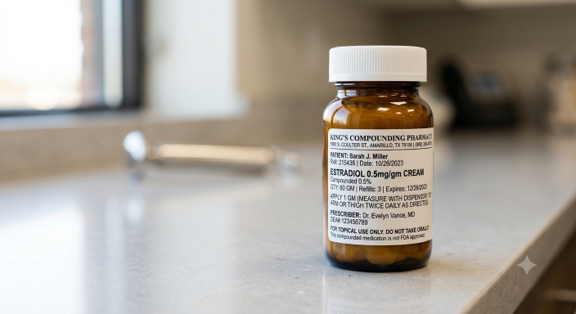
Topical creams and gels — the most common form, applied to a specified area of thin skin and typically dosed by a measured amount. Capsules and oral preparations, including strengths not commercially available. Sublingual troches that dissolve under the tongue. Vaginal suppositories for genitourinary symptoms. Each has different absorption characteristics, and your pharmacist will explain what to expect from yours and how to use it consistently.
Cost, insurance, and what to expect
Compounded medications are often not covered by insurance because they are not FDA-approved products with a billing code, and coverage varies widely by plan. Many patients pay out of pocket. Rather than guess, ask us for a price before you commit — we will quote the preparation your prescriber specifies, and we will tell you if a covered commercial alternative would do the same job for less. For patients exploring this for the first time, our HRT starter package bundles the consultation and initial work-up; call 806-358-4576 for current pricing.
Why a compounding pharmacy in Amarillo matters
Mail-order hormone programs can ship you a cream. What they cannot do is have a licensed pharmacist twenty minutes away who knows your chart, will take a call mid-titration, and can adjust a strength between refills. Hormone therapy is iterative — the first formulation is a starting point, not a verdict — and that iteration works better with a pharmacist you can talk to. We have served Amarillo from the medical center on South Coulter since the early 1980s, and we work with providers across the Panhandle.
Frequently asked questions
Are compounded bioidentical hormones FDA-approved?
No. Compounded preparations are not reviewed by the FDA for safety, quality, or effectiveness. The individual hormone ingredients may be bioidentical to what your body makes, but the finished compounded preparation is not an approved drug product.
Are they safer than conventional hormone therapy?
There is no reliable evidence that compounded bioidentical hormones are safer or more effective than FDA-approved hormone products. The main advantage of compounding is customization, not safety.
Do I need a prescription?
Yes. Compounded hormone therapy is prescription-only. Your prescriber sends us the prescription, and we prepare it to their specifications.
Will my insurance cover it?
Often not, because compounded preparations typically lack a coverage code. Coverage varies by plan — ask us for a quote and we will be straight with you.
How long until I feel a difference?
It varies by patient and by form. Hormone therapy usually requires adjustment after the initial weeks, and your pharmacist and prescriber will work with you on that.
Ready to talk it through? Book a consultation with one of our pharmacists, or call 806-358-4576. If you already have a prescriber, we are glad to work with them — send us their name and we will coordinate directly.