

You started hormone therapy three months ago. Your labs look fine on paper, but you still feel exhausted, foggy, and frustrated. Your doctor adjusts the dose. Nothing changes. Before you assume the treatment is failing, ask a question almost no one asks: what form is your hormone in?
A pill, a cream, a patch, and an injection of the exact same hormone can produce wildly different results inside your body. The molecule is identical. The delivery is not. And that delivery method may be the single most overlooked factor in whether your hormone therapy actually works. A compounding pharmacy can change the form without changing the prescription, and the difference is often dramatic.
Why the Same Hormone Behaves Differently in Different Forms
Hormones are delicate. Once you swallow, apply, or inject one, your body decides how much of it actually reaches your bloodstream. That percentage is called bioavailability, and it changes drastically based on the route of delivery.
Oral Pills: The First-Pass Problem
When you swallow a hormone, it travels through your digestive tract and lands in your liver before it ever reaches the rest of your body. The liver treats it like a foreign substance and breaks down a large portion of it. This is the first-pass effect.
For some hormones, like oral estrogen, this means up to 70 percent of the dose is metabolized before doing anything useful. It also forces the liver to produce more clotting factors and inflammatory proteins, which is why oral estrogen carries a higher clot risk than other forms.
Transdermal Creams and Gels: Steady, Bypassing the Liver
Hormones applied to the skin skip the digestive tract entirely. They absorb slowly into the bloodstream, deliver a steady supply, and avoid the liver workload. For testosterone and estradiol, this often produces more stable mood, energy, and libido than oral dosing.
The catch: skin absorption varies from person to person. Body fat percentage, skin thickness, application site, and even the base the medication is mixed into all change how much hormone actually crosses the skin.
Sublingual and Troche Forms: Fast and Direct
Held under the tongue or against the cheek, these forms absorb through the mucous membranes directly into the bloodstream. They act faster than creams and bypass the liver, but the duration is shorter, so dosing schedules matter.
Injectable Hormones: Maximum Bioavailability
Injections deliver nearly 100 percent of the hormone into the bloodstream. There is no first-pass loss and no skin variability. The result is precise, predictable levels, which is why custom injectable medications are often the gold standard for testosterone replacement and certain estrogen protocols.
The trade-off is the peak-and-trough pattern. Levels spike after injection and slowly fall, which is why injection frequency and dose size both need to be tuned to the individual.
Pellets: Long-Acting and Hands-Off
Tiny hormone pellets implanted under the skin release a steady dose over three to six months. Patients who hate daily creams or weekly injections often prefer this form, though adjustments mid-cycle are difficult once the pellet is in.
Why Your Body Might Not Match the Standard Form
A retail pharmacy can only hand you what the manufacturer makes. If your doctor prescribes a testosterone gel and your skin absorbs it poorly, you are stuck. If oral progesterone makes you drowsy and dizzy, the pharmacy cannot turn it into a topical cream for you.
This is where the form your hormone arrives in becomes a wall, not a tool. And it is the reason so many patients on hormone replacement eventually start looking for something more customizable.
How a Compounding Pharmacy Solves the Form Problem
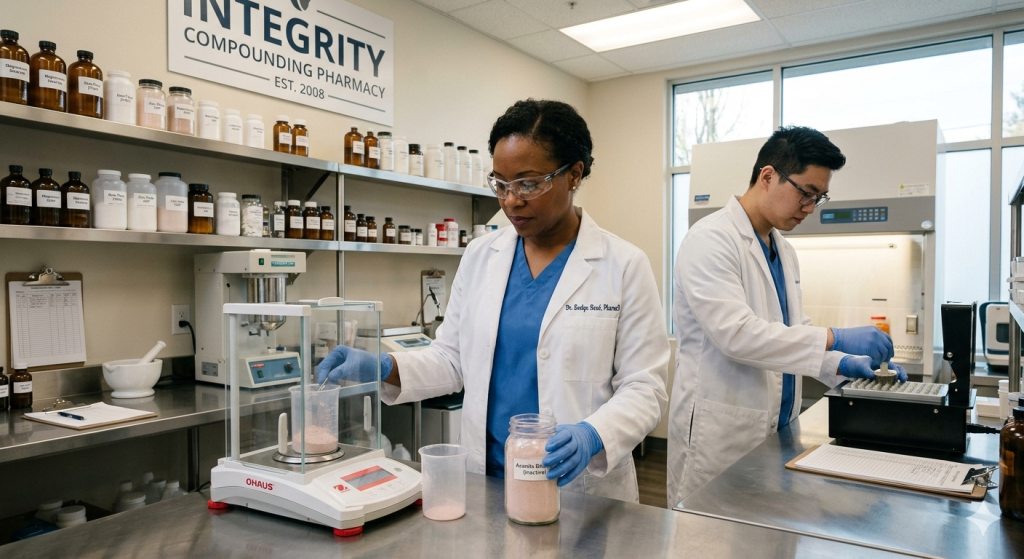
Compounding pharmacists start with the raw active ingredient and build the medication in whatever form your body responds to best. The same hormone can be prepared as:
- A topical cream in a hypoallergenic base
- A sublingual troche or rapid-dissolve tablet
- An oral capsule at a non-standard dose
- A vaginal cream, suppository, or insert
- A custom-concentration injection
- A nasal spray for fast onset
This is not about preference alone. It is about absorption. A patient who fails on oral progesterone may thrive on a vaginal insert. A man who shows no testosterone rise from gel may respond perfectly to a weekly injection at half the expected dose.
When Switching Forms Changes Everything
A few real patterns compounding pharmacists see often:
- A woman on oral estrogen with persistent headaches switches to a transdermal cream and the headaches vanish.
- A man on testosterone gel sees no improvement in energy until his prescription is rebuilt as a custom-strength injection.
- A perimenopausal patient with insomnia tries oral progesterone, gets dizzy, and finds relief with a sublingual troche taken at bedtime.
None of these patients changed their hormones. They changed the form.
How the Right Form Gets Identified
Form selection is not guesswork. A compounding pharmacist looks at your symptoms, your lab work, your lifestyle, your other medications, and your previous reactions before recommending a form to your provider. From there, the prescription is built around you, not pulled from a shelf. If a form is not working after a few weeks, it can be rebuilt without starting from zero.
If your hormone therapy is not delivering the results you expected, the problem may not be the hormone or the dose. It may be the form. Contact King’s Compounding Pharmacy in Amarillo to schedule a consultation and find out which delivery method is actually right for your body.
Frequently Asked Questions
Which hormone form has the best absorption?
Injections have the highest bioavailability, often nearly 100 percent. However, the best form depends on your individual response, lifestyle, and the specific hormone being prescribed. Some patients absorb creams beautifully, while others need injections to see any benefit.
Can I switch hormone forms without changing my prescription?
Your provider will need to update the prescription to reflect the new form and adjusted dose, since strength requirements change between routes. A compounding pharmacist can work directly with your doctor to recommend and prepare the new formulation.
Are custom injectable hormones safer than commercial ones?
Custom injectable medications prepared by a licensed compounding pharmacy follow strict USP sterility standards and are made with high-quality active ingredients. The advantage is precision: the concentration, volume, and frequency can be tailored to your body rather than a manufacturer’s fixed options.
How long does it take to know if a new hormone form is working?
Most patients see early changes within two to four weeks, with full effects appearing around the eight-to-twelve-week mark. Follow-up lab work and symptom tracking help determine whether the form is delivering the expected blood levels.